My blog has moved!
You should be automatically redirected in 5 seconds. If not, visit redirectLink" href='http://www.needinputblog.com'> http://www.needinputblog.com and update your bookmarks/RSS feed.


Showing posts with label business. Show all posts

T-Shaped Creativity

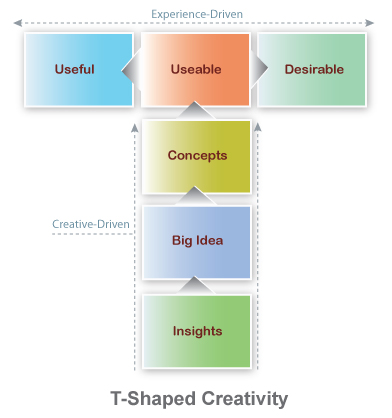
Image by David Armano
As a creative generalist, I pride myself on my tendency to pursue multiple interests and attain a range of skills rather than focusing on one specific expertise.

But we all have strengths in certain areas - there are very few of us who are actually jack of all trades.  T-shaped creativity is a way to showcase these core skills against the secondary skills and knowledge that make us unique as creative thinkers and doers.

T-shaped individuals

I first learned about the concept of T-shaped creativity through Mark McGuinness's Creative Pathfinder course, but IDEO's Tim Brown is also a big proponent of the idea.
  
Basically, the T-Shaped model takes creative generalism a step further, essentially suggesting that we're all both generalists and specialists.  The simple design is a way to map out core skills next to the knowledge and secondary skills that help make these base skills so meaningful.

So, if you look at T-shaped creativity in terms of an individual's skill set, the vertical stroke consists of specialist skills and knowledge while the horizontal stroke comprises generalist skills that allow the individual to position his or her specialism in a way that's useful and desirable for others.
  
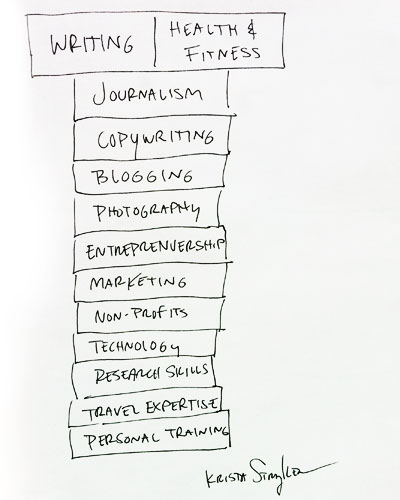
For example, while I typically categorize myself as a creative generalist, I specialize in the following areas:
  • Writing
  • Health and Fitness
These specialties are the vertical stroke of the T, my core skills and knowledge.  My generalist skills are:
  • Journalism
  • Copywriting
  • Freelance writing
  • Blogging
  • Photography
  • Entrepreneurship
  • Marketing
  • Non-profits
  • Technology 
  • Research skills
  • Travel expertise 
  • Personal training
My (doodled) T-Shape, therefore, would look like this:


While my skill set is fairly well-rounded as-is, I'd ideally add a specialty or two and several generalist skills (as well as strengthen some current ones) throughout my lifetime.

T-shaped creativity in the workplace

Companies like design and innovation consulting firm IDEO are making a concerted effort to put together teams of T-Shaped creatives in order to cultivate a more experimental, curiosity-driven workplace.
  
David Armano of Edelman Digital explains the concept of T-shaped team building and how it can fit into a workplace environment (described in more detail in a post on the Marketing Profs Blog):

The notion is simple - cultivate people on your team that have a core competency, but can easily branch out (like the shape of a T).  They ideally possess traits such as curiosity, empathy and aren't afraid to ask why.  And there is a distinction between this type of individual vs. a jack-of-all trades.  The core competency and branches are complimentary, with branches being secondary strengths.  It represents breadth and depth of skills.

His image of how a T-shaped workplace can be applied to the creative process of interactive marketing and experience design is shown above.

Everyone is a generalist

The T-shaped creativity model suggests that while some of us may have a longer vertical stroke (suggesting more of a specialist mindset) and others may have a longer horizontal stroke like my T example (indicating more of a generalist mentality), we are all generalists and specialists to some degree.


What does your T-shape look like?

Why Creativity and Sales Must Co-Exist

© Krista Stryker 2011
It's no secret that most creative people hate sales.  

In fact, I have little doubt that when given the choice between life in jail or a job as a traditional salesperson, most creatives would choose jail.  At least then (many would say), they could still keep their soul.

But what is it about sales that creative people find so abhorrent?  

Memories of sleazy door-to-door salesmen stick in our minds

I, too, long held onto the idea that selling was a near reprehensible enterprise.  I can't help but think my viewpoint might have been encouraged by the fact that Hollywood has always portrayed salesmen (yes, in movies they are always men) as sleazy bastards trying to sell innocent people something that is either overpriced, will likely break in a day or two, or both.  This pop culture representation of salespeople contributed to my idea that:

Salespeople = sleazeballs 

Which in turn meant that:

Selling = evil

Selling doesn't have to mean selling out 

The problem with this outlook is that it doesn't apply to the majority of salespeople.  Sure, you'll always get a few products here and there sold by disreputable people who want to rip you off or don't care if you suffer as long as you put money in their pockets.

But the truth is that in today's post-recession world (some people might insist we are still in a recession), shoddy products, information and services simply will not last long.  Think about the last defective item you bought.  Or the last crappy restaurant you went to.  Or the last how-to book you purchased that had great, enticing headlines but shallow content.  
Would you spend your money on any of those products or services ever again? 

Of course not.  People are smart, and we don't want shitty things.  So next time a shady salesperson tries to sell them to us, we'll know better not to buy.

On the other hand, think of the last piece of electronic equipment (Apple, anyone?), clothing brand (Nike comes to mind), or retailer (a.k.a. Amazon) that you just loved.  Chances are, if there was someone selling you that product, they didn't have to work very hard to convince you to buy it.  The product itself was so good you may have even found yourself thanking the salesperson for giving you the opportunity to spend your money on their product or service.  

So all it takes is a quality product and the evil salesperson image is shattered.  

The romantic myth of a starving artist 

I can tell what you're thinking. That's great for Apple and Nike, you say, but I still refuse to sell.  I am an artist, after all.

That's pure bullshit.  (Yes! I said it.)

You may be the most talented artist on earth, but if no one knows about you, you might as well not exist.  Your paintings, novels, blog posts, computer programs, logos, etc. may as well not exist either.

You probably have an image in your head about the life of a starving artist as a romantic, strangely enticing way to live until you reach stardom (or die, and then your work becomes famous).  So you sit at home eating nothing but Ramen and waste your days away, or worse, work at a coffee shop or wait tables while not actually doing any of your true work, just hoping that one day you'll run into someone who will discover you and turn your world upside down.

That too is bullshit.  

There are too many people putting themselves out there, too many people in the world in general, for you to be "discovered."  (Let's put it at a .001 percent chance - not impossible, but extremely unlikely.)

The answer?

You have to sell something. 

Yes, you!  You will become a salesperson.  And a damn good one, at that, if you want to compete in this world of other salespeople and artists.

You will sell your products, your brand, yourself - so that the world is aware of your existence.  So that the world can experience what you have to offer, try your products, see your art.

The good news?  If what you're selling is truly valuable, you'll have no problem.  This is not to say that it won't take you a while (the chances of overnight success are probably a great deal less than .001 percent), but if you really are selling something great, the world will be on your side.  And then, just like dedicated Apple addicts do with new Mac products, your customers (or readers, viewers, etc.) will be lining up on your doorstep just hoping that you will allow them to buy your product.

Publishing is Dead as We Know it

For those of you who may have missed it, I heard a great podcast the other day from Radio Litopia called, "Seth Godin: The New Face of Publishing."

As someone who is particularly interested in the publishing industry (there was a time when I thought it might just be my dream job), and a longtime book devourer, I found Seth's take on the future of book publishing fascinating.
  
I'd be scared shitless if I were a CEO in Random House, Simon & Schuster, or one of the other mega publishing houses out there.
  
On the other hand, Seth's words are incredibly hopeful to any aspiring writers (such as myself) who want to reach a larger audience with what they have to say without the need for an often pointless middleman.

Check out the podcast here, or sign up for all of Litopia's podcasts through iTunes.  And for even more on the issue, take a look at Seth's new venture, The Domino Project, a sneak peek into what publishing may turn into in years to come.