My blog has moved!
You should be automatically redirected in 5 seconds. If not, visit redirectLink" href='http://www.needinputblog.com'> http://www.needinputblog.com and update your bookmarks/RSS feed.


Showing posts with label writing. Show all posts

Five Lessons Your Dog Can Teach You About Blogging

© Krista Stryker 2011
There's a reason why dogs are so often called man's best friend.

They're devoted to us.  They make us laugh.  They're always there to greet us after a long day.

In fact, dogs can teach us a thing or two about blogging.  Or more specifically, five things: 

1.  Loyalty 

Any dog lover knows that one of the best things about the furry creatures is that they're incredibly loyal.  They'll stick by your side no matter what.

This same lesson can be applied to blogging.  If you're loyal to your readers, if you stick with them through their ups and downs, and pay attention to their comments and concerns, they'll return the loyalty.  

In turn, this loyal readership will translate into higher traffic numbers, greater RSS/e-mail subscription rates and if you offer products or services on your blog, higher sales.  

2.  Personality 

Though she may annoy me at times with her constant need for attention, my two-year-old Beagle, Rocket (pictured above), is never short on personality.  She has an endless number of quirks, and I would never mistake another dog for her because of these easily recognizable traits.

Similarly, you need to insert your personality into your blog.  Your readers want to get to know you, and will relate to your posts much more if you talk about your kids, the terrible day you had yesterday, or of course, your pets.  

Just make sure you relate your experiences back to your blog topic so your readers don't get lost.

3.  Humor

Another reason dogs make great companions: they make us laugh.  

Dogs have all sorts of funny habits that make us humans smile even when we're having a bad day.  My dog does this thing my husband and I call "flat dog" - she lays on her belly with all four legs extended, seemingly defying the laws of physics - and it never ceases to get a chuckle out of me. 

Add humor to your blog posts!  Humor lifts the mood of any writing, and can be especially beneficial to lighten up a more boring, informational topic, but adds value to any post.

4.  Playfulness

Rocket is always ready to play.  As a Beagle, she's not as into playing fetch as other breeds, but one of her favorite activities in the entire world is to go to the dog park.  

She'll run in circles and play with the other dogs for as long as I can keep myself from getting bored (I know, bad owner).  

Add a sense of playfulness to your blog posts.  

I realize this isn't possible with every topic and every post, but readers will be much more likely to want to come back if you add some fun here and there to your writing rather than keeping it all doom and gloom and seriousness.  

5.  Forgiveness 

Going along with their loyalty tendencies, dogs have a wonderful ability to forgive, no matter what.  

For instance, I just gave my dog a bath - her least favorite activity in the world aside from being in a car - and though she was not exactly happy at the time, she quickly forgave me and is now laying at my feet while I write.

Forgive your readers if they don't like your post.  

Or if someone makes a mean comment you don't think you deserved, or don't comment as often as you'd like.  

Or, simply, if they choose to not come back.  

You can't please everyone all of the time.  

Just do your best to keep readers as engaged as possible, and don't take it personally when someone criticizes you or doesn't like what you have to say.

Similarly, forgive your fellow bloggers for their bad days as well - no one is perfect!


So the next time you're looking for blogging inspiration, look no further than your four-legged friend.  That wagging tail may be just the push you need to spark your creativity and get your blog to the next level.

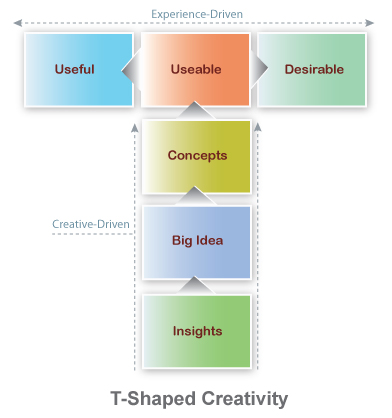
T-Shaped Creativity

Image by David Armano
As a creative generalist, I pride myself on my tendency to pursue multiple interests and attain a range of skills rather than focusing on one specific expertise.

But we all have strengths in certain areas - there are very few of us who are actually jack of all trades.  T-shaped creativity is a way to showcase these core skills against the secondary skills and knowledge that make us unique as creative thinkers and doers.

T-shaped individuals

I first learned about the concept of T-shaped creativity through Mark McGuinness's Creative Pathfinder course, but IDEO's Tim Brown is also a big proponent of the idea.
  
Basically, the T-Shaped model takes creative generalism a step further, essentially suggesting that we're all both generalists and specialists.  The simple design is a way to map out core skills next to the knowledge and secondary skills that help make these base skills so meaningful.

So, if you look at T-shaped creativity in terms of an individual's skill set, the vertical stroke consists of specialist skills and knowledge while the horizontal stroke comprises generalist skills that allow the individual to position his or her specialism in a way that's useful and desirable for others.
  
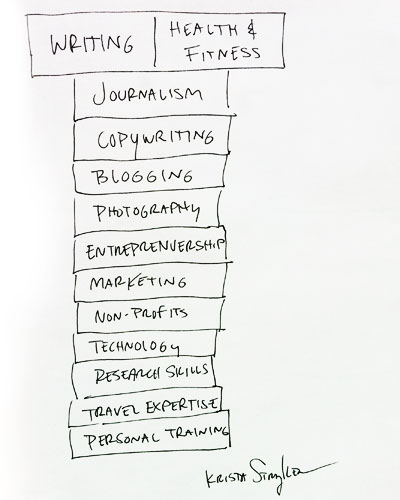
For example, while I typically categorize myself as a creative generalist, I specialize in the following areas:
  • Writing
  • Health and Fitness
These specialties are the vertical stroke of the T, my core skills and knowledge.  My generalist skills are:
  • Journalism
  • Copywriting
  • Freelance writing
  • Blogging
  • Photography
  • Entrepreneurship
  • Marketing
  • Non-profits
  • Technology 
  • Research skills
  • Travel expertise 
  • Personal training
My (doodled) T-Shape, therefore, would look like this:


While my skill set is fairly well-rounded as-is, I'd ideally add a specialty or two and several generalist skills (as well as strengthen some current ones) throughout my lifetime.

T-shaped creativity in the workplace

Companies like design and innovation consulting firm IDEO are making a concerted effort to put together teams of T-Shaped creatives in order to cultivate a more experimental, curiosity-driven workplace.
  
David Armano of Edelman Digital explains the concept of T-shaped team building and how it can fit into a workplace environment (described in more detail in a post on the Marketing Profs Blog):

The notion is simple - cultivate people on your team that have a core competency, but can easily branch out (like the shape of a T).  They ideally possess traits such as curiosity, empathy and aren't afraid to ask why.  And there is a distinction between this type of individual vs. a jack-of-all trades.  The core competency and branches are complimentary, with branches being secondary strengths.  It represents breadth and depth of skills.

His image of how a T-shaped workplace can be applied to the creative process of interactive marketing and experience design is shown above.

Everyone is a generalist

The T-shaped creativity model suggests that while some of us may have a longer vertical stroke (suggesting more of a specialist mindset) and others may have a longer horizontal stroke like my T example (indicating more of a generalist mentality), we are all generalists and specialists to some degree.


What does your T-shape look like?

The Voices Inside My Head

© Krista Stryker 2011
The title of this post probably makes me sound crazy.

(I am, but that's besides the point.)

The voices I'm referring to are our creative voices (or images) - the ones that give us ideas for our creative work.

In my case, the voices come out in the form of a story, a manifesto, or something writing-related.  

Non-writers may instead see logos they want to design, images they want to paint or computer code they want to program.

All that matters is that these voices exist, and that you listen to them.

There was a time in my life not very long ago that I ignored these voices.  I thought they were stupid.  I thought I was stupid.  I forgot I was a creative person and instead shut myself off to the world.

The result: I was miserable.

Now that I've opened up my creative mind again the voices are almost screaming at me.  I have so many ideas they crisscross one another and fight to get out.  If this were a sci-fi movie, I would just insert a USB drive (or whatever the new technology will be in the future) into my brain and the thoughts would flow right out of my subconscious before I forgot even one precious word (more thoughts on computerized brains in this post I wrote).

Alas, technology has not come to that point yet.  Now, whenever the voices strike, I am forced to scurry to my computer/iPhone/notepad and type/write as fast as I am capable of before I forget their existence. 

How do you respond to the creative voices in your head?

Writing Challenge: Trust Yourself

© Krista Stryker 2011
To my fellow writers and creative thinkers out there: 

I've made a commitment to take on a writing challenge inspired by the great Ralph Waldo Emerson himself.  The challenge encourages you to look within and trust yourself, and will act as an opportunity to reflect on the now and create direction for your future.  
The #Trust30 challenge starts May 31, 2011 and continues for 30 days.  Here are the rules:
  • Each day a prompt will be posted (and e-mailed to you if you need a reminder) by an original thinker and doer on http://ralphwaldoemerson.me.
  • Fill out the pledge on the challenge website to commit to participating.
  • Blog, journal or create something on each of the 30 days.
  • Tweet using the hashtag #Trust30 to show your support and involvement.
Pretty cool, huh?

I will be using Twitter to post my daily prompt responses but I will also use this site for longer thoughts.

Join me in this challenge!

Learning to Fail, One Step at a Time

© Krista Stryker 2010
I moved to Amsterdam three years ago full of dreams of how I would spend my time there, yet it took only a year of constant failure to make me feel like a worthless human being.

I had certainly run into my fair share of bad luck.  My husband worked for Nike at the time, and we moved over there thinking I'd have no problem getting a job (a bright young college graduate with exciting ideas - who wouldn't want to hire me?).  But I had plenty of factors going against me:
  • The recession had just hit the US and was quickly radiating to the rest of the world, including Europe.
  • I didn't speak Dutch (this turned out to be a much bigger issue than I'd thought)
  • Being a relatively recent college graduate, I didn't have the mandatory 3-5 years of experience required by most of the companies there.
  • I didn't have an area of "specialty." 
Combine these external factors with the reality that I didn't know what the hell I actually wanted to do with my life, and it's pretty obvious why I may have had a lot of failed attempts.

Try and try again 


Though I had been a journalist before moving to the Netherlands, I realized pretty quickly after moving that I would have to be open to different opportunities.

So I tried getting a job at my husband's company.  No dice (not enough experience/no specialty).  

I tried working as an English-language correspondent for a Dutch newspaper.  They told me I needed to learn to read Dutch better - though I thought I could do the job just fine using a dictionary and Google translate (if you're wondering, I did take Dutch lessons, but it is not an easy/desirable language to learn).

I got my personal training certification and tried working at a gym just to have something to do.  Again, not enough Dutch (mind you, every Dutch person can speak English, they are just stubborn about it because they know Dutch is a dying language).  

I applied to every job I could think of with no luck.  Eventually I just gave up.  

Learning to fail


Giving up was the worst thing I could have done.  It made me lose my hope and my passion for life.  It made me think that I was worthless, that I used to be smart/interesting/ambitious/creative but that somewhere along the line I'd made a wrong decision and there was nothing I could do about it.  I was doomed to live an unfulfilling life.  In short, I was screwed.

But of course I was having a tough time.  I was living in a foreign country where I had no contacts, resources or people to help me.  I missed my family.  I was lonely.  The worst recession since the Great Depression had hit just as I had graduated college.  It was a tough time for a lot of people.  It still is.

Things gradually started to pick up for me, but only after I started accepting the following:
  • That I never want a real job (I define a real job as a 9 to 5 job at some sort of company or corporation, involving lack of freedom, creativity etc., but feel free to add your own interpretations).
  • That I actually am a creative person, and I do have something to say and contribute to the world.
  • That I haven't chosen the easiest path, but ultimately it will be the most fulfilling.
Everyone fails.  The key to success is to keep trying and to learn from your mistakes.

I know I'll get it right eventually.

Overcoming Obstacles: How the Possible Loss of My Right Arm Made Me Cherish Writing Again

Last night I woke up in the middle of the night with someone else's arm underneath me (not my husband's).  I panicked.  Whose arm was this?  Why was it in my bed?

It took me a few groggy seconds to realize it was my own arm.  But it had fallen completely asleep.  I've had limbs fall asleep before, but never anything like this.  It felt like jello was attached to my shoulder.  I couldn't feel or move it.  The thought, "am I going to lose my arm?" came to my mind and I nearly screamed.

Of course, it took a second (longer than normal, mind you - this arm was really asleep), but I soon felt the blood rushing back into my hand.  It was a strange experience, almost like I could feel all of my blood vessels that had previously been empty and on the verge of dying refill with life.  

I'm happy to say I have a working arm today.  But I can't help but think the experience was my body/mind/subconscious trying to tell me something.

Lately, I've awoken from a writing slumber.  I've always considered myself a writer, but in the past few years thought maybe I'd just run out of ideas, that I had nothing to say.  It took an online course given by Mark McGuinness (thanks Mark) to help me realize that I was a creative person and I would never be content in a boring, unchallenging 9 to 5 job (such as the ones I'd recently interviewed for).  

I'm right handed, so the loss of my right hand would have been pretty debilitating.  It may have even quelled my desire to write (at least for a while).  Could this have been what Steven Pressfield (author of The War of Art and more recently Do the Work), calls Resistance*?  Could certain forces been trying to stop me from writing by taking away my most useful writing tool - my right arm?

It won't work.  Not this time.

*In his book, The War of Art: Break Through the Blocks and Win Your Inner Creative Battle, Steven Pressfield defines Resistance as the naysayer within that creates roadblocks for any creative endeaver.  This internal foe must be defeated to achieve the greatest success and reach the highest level of creative discipline.